Well, nothing much has been happening around here, except work and getting ready for my senior recital and for a violin quartet. Also, John came home for his two week vacation from TAC, and it's been great having him back. His being here, it makes me feel a lot of different things, but mostly a sort of homesickness for TAC, and a sad feeling that I won't be at college with him next year, but I'm very, very excited to be off to UD this fall. I know that I'm going to have a great year, and as always, I trust in the will of God for my future. We'll see...
Whenever I have a spare minute or two, I'm usually outside or reading. I recently finished a Willa Cather spree, which consisted of My Antonia, O Pioneers, and The Song of the Lark. All of them were remarkable, great books to read anytime. After that I tried 1984, by George Orwell, but after the first few chapters, I just couldn't stick with it. I'll try to pick it up again later, but another reason I stopped was that I was really excited to start Kristin Lavransdatter, by Sigrid Undset. I've read the first two books before, but got lost in the third. So far so good this time. It's really an amazing book with its imagery and realistic medieval Norwegian setting.
I have quite an extensive list for the rest of the summer, so I'll update you as soon as I read more.
Let me know what you're all up to this summer!
God bless.
Tuesday, May 30, 2006


Wednesday, May 24, 2006
Questions
Hey everyone! Here is a survey I found on a friend's blog. Feel free to write your own answers in the comments.
1. What does your MySpace headline mean?
Well, on MySpace it is "The Drama of Existence searches for its own Truth," which basically means that if we are truly living, we are seeking the Truth. Not what the world tells us is truth, but what the drama inside us desires: Christ.
2. Elaborate on your default photo:
At the TAC summer program dinner. Good times...
3. What's your middle name?
Elizabeth
4. What is your current relationship status?
blessed with many awesome friends
5. What EXACTLY are you wearing right now?:
A tan a-line skirt, and a salmon colored cap-sleeve shirt. Earlier I had on a white 3/4 length sweater, but it got too hot. (98, I think)
6. What is your current problem?
I have to rehearse the entire Bruch concerto tomorrow by memory, and I am nervous.
7. What do you love the most?
God, Life, people (family and friends), beauty, chocolate, and good books and movies. Not to mention great times.
8. What makes you most happy?
doing what I'm supposed to do
9. Are you musically inclined?
Considering I'm giving a senior recital here pretty soon, I would say so.
10. If you could go back in time, and change something, what would it be?
I would have smiled at or talked to all those people that needed it, like the people you randomly meet at the gas station or in the checkout line.
11. If you MUST be an animal for ONE day what would you be?
a bird: I would fly around the world
12. Ever have a near death experience?
maybe not so near death as most
13. Name an obvious quality you have:
I'm an organizer and a listener
14. What's the name of the song that's stuck in your head right now?
I have several songs simultaneously in my head, most notably "Far Away" by Nickelback, and "Dreaming of You" by Selena, because my 3 year old sister sings it all day (Selena, not Nickelback).
15. Who did you cut and paste this from?:
the one, the only, Nicole Habashy
16. Name someone with the same b-day as you:
Christa Cannizarro, Mahatma Ghandi, Kelly Ripa, Sting, Don McLean
17. Have you ever vandalized someone's private property?
not exactly
18. Have you ever gotten in a fight?
yes
19. Have you ever sang in front of a large audience?
not solo
20. What's the first thing you notice about the OPPOSITE sex?
face, smile, how they treat other people (sorry, that's 3)
21. What do you usually order from Starbucks?
hot chocolate or chai tea latte
23. Ever had a drunken night in Mexico?
no
25. Do you still watch kiddy movies or TV shows?
YES!! Beauty and the Beast is the BEST movie.
26. Did you have braces?
not now, but I did
27. Are you comfortable with your height?
very much so
28. What is the most romantic thing someone has ever done?
I'm not very experienced in the romance department, but a good friend of mine said that I am beautiful.
29. Do you speak any other languages?
spanish, a little italian, and I know a song in irish
30. What's your favorite smell?
rain, Ralph Lauren Blue
1. What does your MySpace headline mean?
Well, on MySpace it is "The Drama of Existence searches for its own Truth," which basically means that if we are truly living, we are seeking the Truth. Not what the world tells us is truth, but what the drama inside us desires: Christ.
2. Elaborate on your default photo:
At the TAC summer program dinner. Good times...
3. What's your middle name?
Elizabeth
4. What is your current relationship status?
blessed with many awesome friends
5. What EXACTLY are you wearing right now?:
A tan a-line skirt, and a salmon colored cap-sleeve shirt. Earlier I had on a white 3/4 length sweater, but it got too hot. (98, I think)
6. What is your current problem?
I have to rehearse the entire Bruch concerto tomorrow by memory, and I am nervous.
7. What do you love the most?
God, Life, people (family and friends), beauty, chocolate, and good books and movies. Not to mention great times.
8. What makes you most happy?
doing what I'm supposed to do
9. Are you musically inclined?
Considering I'm giving a senior recital here pretty soon, I would say so.
10. If you could go back in time, and change something, what would it be?
I would have smiled at or talked to all those people that needed it, like the people you randomly meet at the gas station or in the checkout line.
11. If you MUST be an animal for ONE day what would you be?
a bird: I would fly around the world
12. Ever have a near death experience?
maybe not so near death as most
13. Name an obvious quality you have:
I'm an organizer and a listener
14. What's the name of the song that's stuck in your head right now?
I have several songs simultaneously in my head, most notably "Far Away" by Nickelback, and "Dreaming of You" by Selena, because my 3 year old sister sings it all day (Selena, not Nickelback).
15. Who did you cut and paste this from?:
the one, the only, Nicole Habashy
16. Name someone with the same b-day as you:
Christa Cannizarro, Mahatma Ghandi, Kelly Ripa, Sting, Don McLean
17. Have you ever vandalized someone's private property?
not exactly
18. Have you ever gotten in a fight?
yes
19. Have you ever sang in front of a large audience?
not solo
20. What's the first thing you notice about the OPPOSITE sex?
face, smile, how they treat other people (sorry, that's 3)
21. What do you usually order from Starbucks?
hot chocolate or chai tea latte
23. Ever had a drunken night in Mexico?
no
25. Do you still watch kiddy movies or TV shows?
YES!! Beauty and the Beast is the BEST movie.
26. Did you have braces?
not now, but I did
27. Are you comfortable with your height?
very much so
28. What is the most romantic thing someone has ever done?
I'm not very experienced in the romance department, but a good friend of mine said that I am beautiful.
29. Do you speak any other languages?
spanish, a little italian, and I know a song in irish
30. What's your favorite smell?
rain, Ralph Lauren Blue
Wednesday, May 10, 2006

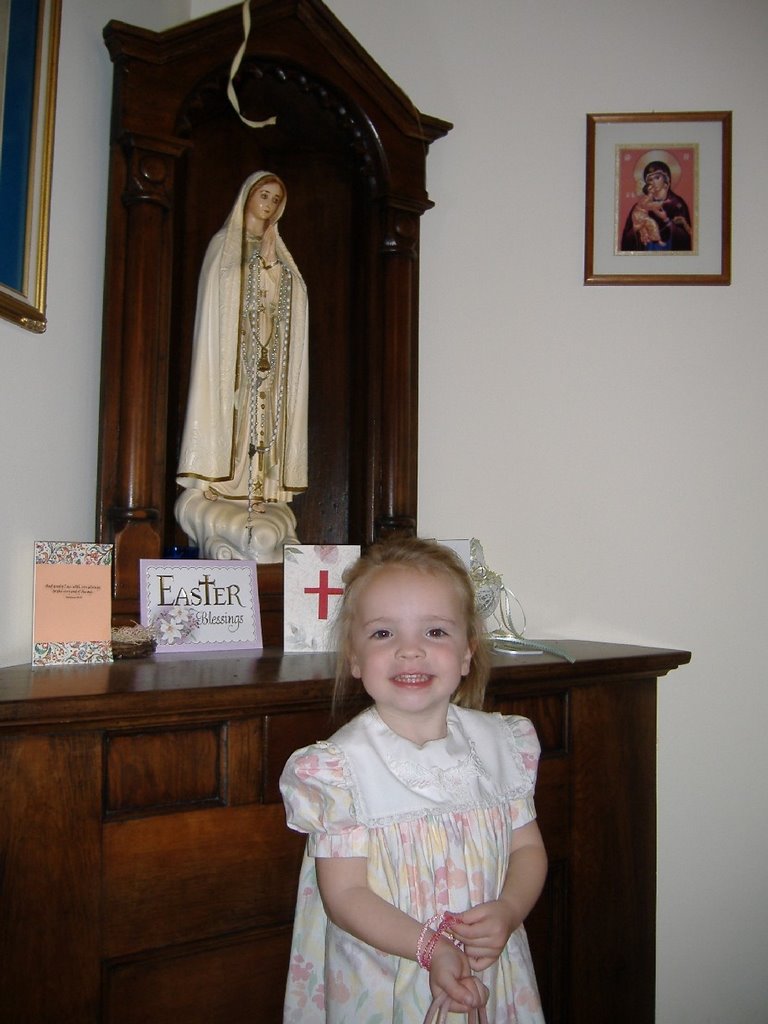
Sunday, April 16, 2006
Christ is Risen!
Rejoice and be glad!
The strength of God is the joy of His people.
-Fr. Giussani
Happy Easter!
And Happy Birthday to our Holy Father, Pope Benedict XVI!
The strength of God is the joy of His people.
-Fr. Giussani
Happy Easter!
And Happy Birthday to our Holy Father, Pope Benedict XVI!
Saturday, April 15, 2006
A Gaze to Our Destiny
I would like to wish everyone a beautiful and blessed Easter Season! In these days, the holiest time of the year, may you all be moved by your redemption by Christ, and feel His Presence with you throughout your life.
I just wanted to say a few words on a movie that is very appropriate for this time: The Passion of the Christ. We watched it last night, on Good Friday, and I must say that there aren't many more beautiful and powerful reflections on Christ's passion and death than this one. What will not--can not--leave me is the gaze of Christ, as he looks at the disciples, Mary Magdalen, Pilate, and most powerfully for me, His mother Mary and Simon of Cyrene. Just the way Jesus looks at them is enough to touch their hearts and change their lives forever.
The look in Christ's eyes touched Mary Magdalen in such a way that she left everything to follow Him.
It touched Pilate in such a way that for the rest of his life he would ask himself, Quid est veritas? What is truth?
It touched Simon of Cyrene in such a way that he left Golgatha with the gaze of Christ written on his soul, never to leave his memory.
It touched Mary, the Mother of God, in such a way throughout her whole life that she saw the fulfillment of the promise of redemption in Jesus' eyes as he said, See, mother, I make all things new.
If He was to look at me like this, how could I say 'no' to this Man? How could any of us? And when we see the Face of Christ in the people we meet, in our friends and family, how can we say 'no' to Him? The choice to love always comes from saying 'yes' to the Person of Christ, in Himself and in others.
To quote Fr. Giussani: "Do not weep! There is a gaze and a heart that penetrates to your very marrow and loves you all the way to your destiny, a gaze and a heart that no one can deflect from His course, no one can render incapable of saying what He thinks and what He feels, no one can render powerless!"
To all of you who show me the Face of Christ each day, thank you.
Have a Happy and Blessed Easter!
God Bless
I just wanted to say a few words on a movie that is very appropriate for this time: The Passion of the Christ. We watched it last night, on Good Friday, and I must say that there aren't many more beautiful and powerful reflections on Christ's passion and death than this one. What will not--can not--leave me is the gaze of Christ, as he looks at the disciples, Mary Magdalen, Pilate, and most powerfully for me, His mother Mary and Simon of Cyrene. Just the way Jesus looks at them is enough to touch their hearts and change their lives forever.
The look in Christ's eyes touched Mary Magdalen in such a way that she left everything to follow Him.
It touched Pilate in such a way that for the rest of his life he would ask himself, Quid est veritas? What is truth?
It touched Simon of Cyrene in such a way that he left Golgatha with the gaze of Christ written on his soul, never to leave his memory.
It touched Mary, the Mother of God, in such a way throughout her whole life that she saw the fulfillment of the promise of redemption in Jesus' eyes as he said, See, mother, I make all things new.
If He was to look at me like this, how could I say 'no' to this Man? How could any of us? And when we see the Face of Christ in the people we meet, in our friends and family, how can we say 'no' to Him? The choice to love always comes from saying 'yes' to the Person of Christ, in Himself and in others.
To quote Fr. Giussani: "Do not weep! There is a gaze and a heart that penetrates to your very marrow and loves you all the way to your destiny, a gaze and a heart that no one can deflect from His course, no one can render incapable of saying what He thinks and what He feels, no one can render powerless!"
To all of you who show me the Face of Christ each day, thank you.
Have a Happy and Blessed Easter!
God Bless
Monday, April 03, 2006
Sentences on Hope
Okay, so I stole my post title from Thomas Merton (No Man Is An Island), but it just so happens that it fits perfectly with the theme of the CL Lenten retreat that I went to this past Saturday. The whole day was beautiful—driving up with my Dad at 5am, watching an amazing sunrise in the Flint Hills, walking around the BC campus which is just beginning to be filled with the sights and smells of the new season, seeing old friends and meeting new ones, and of course participating in the retreat itself.
The theme of the 2005 CL Spiritual Exercises, “Hope Does Not Disappoint,” was also the theme of the retreat. In a simple yet profound meditation on the second lesson of the exercises, led by Fr. Jerry from Minnesota, we asked the questions: “What is the hope that does not disappoint?” and “where is this place of hope in my life?”
Let’s back up for a moment, though, and ask ourselves this: “Do we even have hope?” Because in a sense, faith is easy—it’s natural. How could we look at the beauty and wonder of the world and say that God doesn’t exist? The same with charity, or love: how could we look at our fellow men and not love the face of Christ that we see in each of them? But hope is not natural to us. The man who has hope, writes Peguy, amazes even God. How is it that we are able to wake up every morning, get out of bed, and tell ourselves that today is going to be better? Time after time we are disappointed, yet time after time we continue to hope.
What, then, is the hope that does not disappoint? It is hope is Christ, the promise and fulfillment of our lives, that can never let us down. “Hope does not disappoint us, because God’s love has been poured into our hearts through the Holy Spirit which has been given to us.” (Romans 5:5) Hope does not come or go forward by itself—you had to have received a great grace. The greatest grace we have received is the encounter with Christ. This encounter opens a path which, to follow, we must continually recognize this grace. In living with His Presence and recognizing the signs of Christ in our lives, we will have the hope that does not disappoint. But we must remember that this journey is for our whole lives: “I believe that not even when we have found Him will we stop looking for Him.”(St. Bernard) “Our hearts are restless until they rest in You.” (St. Augustine)
Where do we find this hope here on earth? In the place of hope, which is the Christian community. But I go to Mass, receive Communion, and go to Confession, and still I cannot hold onto hope. This reality forces us to ask yet another question: “Who are my friends?” Surrounding ourselves with people who are striving towards the same goal, and who are asking the same questions, is a crucial part of living the Christian community. Thomas Merton expressed this beautifully: “For in my soul and in your soul I find the same Christ Who is our Life, and He finds Himself in our love, and together we both find Paradise, which is the sharing of His love for His Father in the Person of Their Spirit.” Later he writes that if our souls are closed to that love, we are “denied the particular expressions which it finds through me and no other.” (both from New Seeds of Contemplation) This is an amazing proposition: that each of us uniquely expresses God’s love—and hope—to each other.
The community we need is a web of relationships that continually awakens our desire for Christ and our recognition of His Presence. These are our friends—those that we can share our lives with. What an awesome responsibility we have: to be the Face of the Presence for our friends.
The only hope that does not disappoint is this powerful Presence of You, Christ, made possible by the Spirit, because without You we put our hope where sooner or later we will be disappointed. You are the only hope that does not disappoint us, Christ.
Veni Sancte Spiritus; Veni Per Mariam
The theme of the 2005 CL Spiritual Exercises, “Hope Does Not Disappoint,” was also the theme of the retreat. In a simple yet profound meditation on the second lesson of the exercises, led by Fr. Jerry from Minnesota, we asked the questions: “What is the hope that does not disappoint?” and “where is this place of hope in my life?”
Let’s back up for a moment, though, and ask ourselves this: “Do we even have hope?” Because in a sense, faith is easy—it’s natural. How could we look at the beauty and wonder of the world and say that God doesn’t exist? The same with charity, or love: how could we look at our fellow men and not love the face of Christ that we see in each of them? But hope is not natural to us. The man who has hope, writes Peguy, amazes even God. How is it that we are able to wake up every morning, get out of bed, and tell ourselves that today is going to be better? Time after time we are disappointed, yet time after time we continue to hope.
What, then, is the hope that does not disappoint? It is hope is Christ, the promise and fulfillment of our lives, that can never let us down. “Hope does not disappoint us, because God’s love has been poured into our hearts through the Holy Spirit which has been given to us.” (Romans 5:5) Hope does not come or go forward by itself—you had to have received a great grace. The greatest grace we have received is the encounter with Christ. This encounter opens a path which, to follow, we must continually recognize this grace. In living with His Presence and recognizing the signs of Christ in our lives, we will have the hope that does not disappoint. But we must remember that this journey is for our whole lives: “I believe that not even when we have found Him will we stop looking for Him.”(St. Bernard) “Our hearts are restless until they rest in You.” (St. Augustine)
Where do we find this hope here on earth? In the place of hope, which is the Christian community. But I go to Mass, receive Communion, and go to Confession, and still I cannot hold onto hope. This reality forces us to ask yet another question: “Who are my friends?” Surrounding ourselves with people who are striving towards the same goal, and who are asking the same questions, is a crucial part of living the Christian community. Thomas Merton expressed this beautifully: “For in my soul and in your soul I find the same Christ Who is our Life, and He finds Himself in our love, and together we both find Paradise, which is the sharing of His love for His Father in the Person of Their Spirit.” Later he writes that if our souls are closed to that love, we are “denied the particular expressions which it finds through me and no other.” (both from New Seeds of Contemplation) This is an amazing proposition: that each of us uniquely expresses God’s love—and hope—to each other.
The community we need is a web of relationships that continually awakens our desire for Christ and our recognition of His Presence. These are our friends—those that we can share our lives with. What an awesome responsibility we have: to be the Face of the Presence for our friends.
The only hope that does not disappoint is this powerful Presence of You, Christ, made possible by the Spirit, because without You we put our hope where sooner or later we will be disappointed. You are the only hope that does not disappoint us, Christ.
Veni Sancte Spiritus; Veni Per Mariam
Friday, March 17, 2006
Pictures
Here are some pictures from our Youth Symphony Concert:
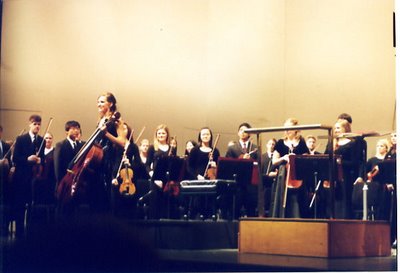
Annamarie played the Dvorak Cello Concerto with the Youth Symphony.
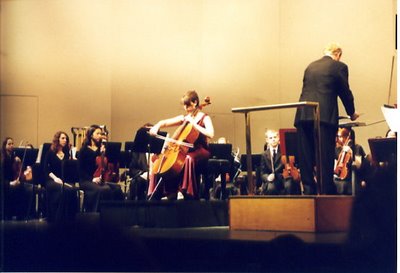
Jenni played a Saen-Sans Cello Concerto with the Repertory Orchestra.
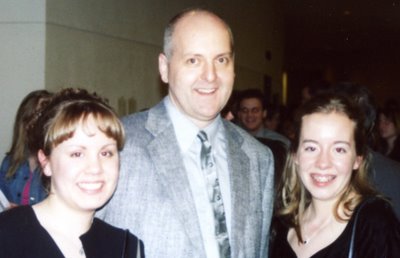
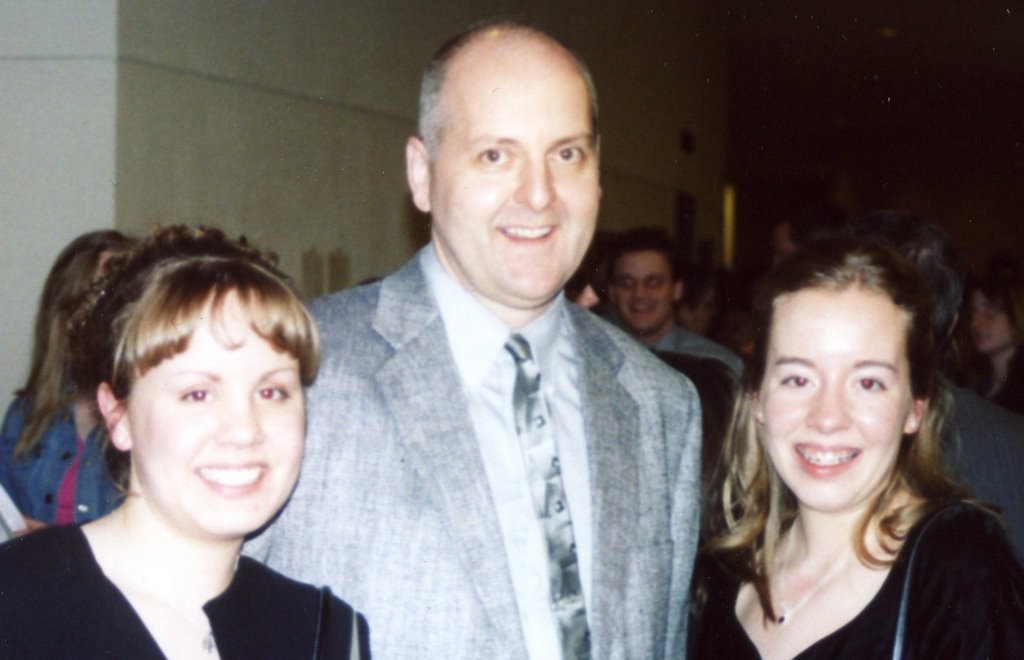
Jen and I with Mr. McHugh. Our family has bought seven violins from him.
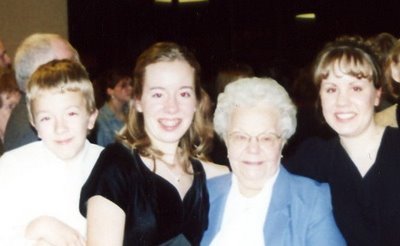
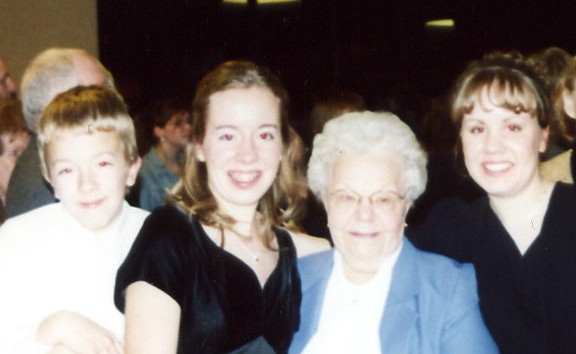
Mike, Jen, and I with our Grandma.
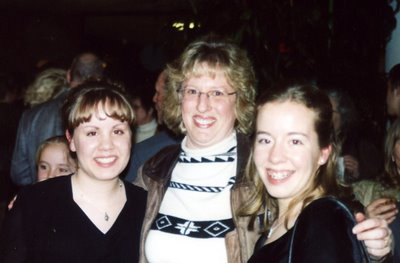
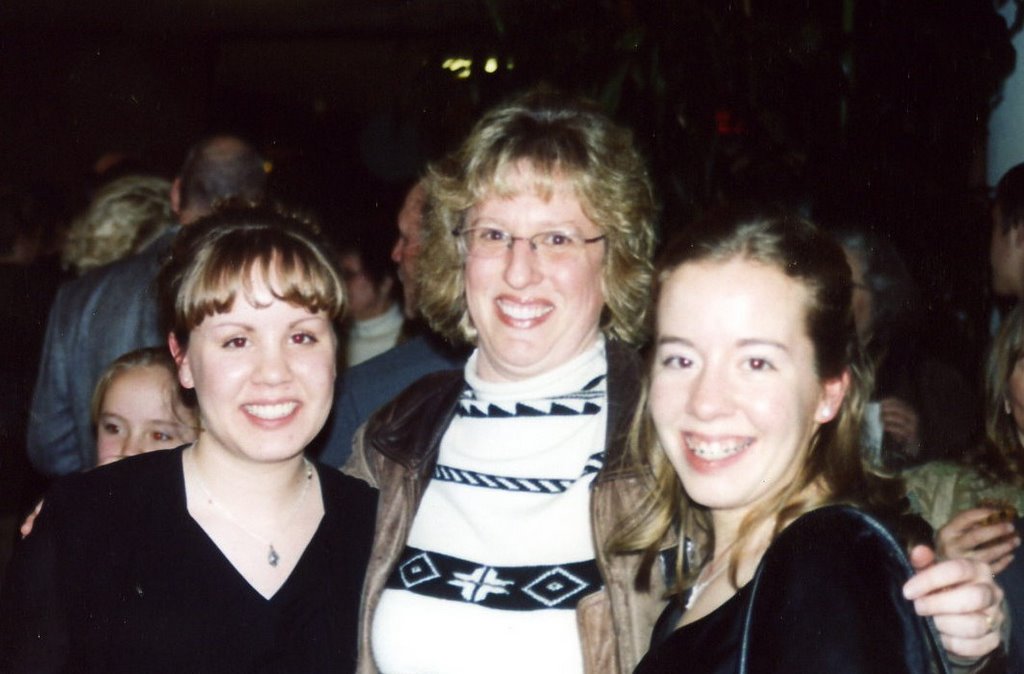
Jen and I with our violin teacher (12 years for me), Mrs. Black.
And randomly...
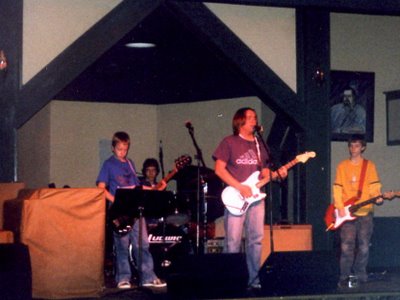
...Jeddy at the Roadhouse.
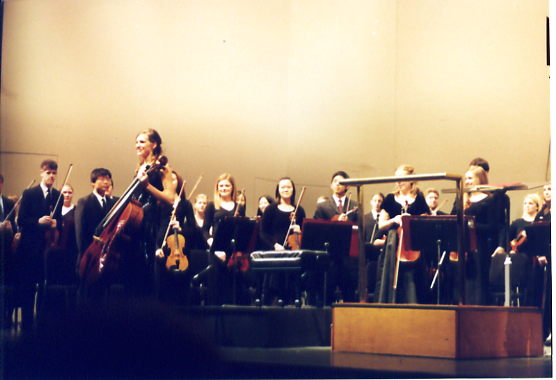
Annamarie played the Dvorak Cello Concerto with the Youth Symphony.

Jenni played a Saen-Sans Cello Concerto with the Repertory Orchestra.
Jen and I with Mr. McHugh. Our family has bought seven violins from him.
Mike, Jen, and I with our Grandma.
Jen and I with our violin teacher (12 years for me), Mrs. Black.
And randomly...

...Jeddy at the Roadhouse.
Friday, March 03, 2006
The Music that Moves My Soul and the Saturday Mornings that Changed My Life
March 4, 2006, will be one of the happiest days of my life, but also on that day, I will lose part of myself. It will not be an unexpected loss, but rather an inevitable one that I have foreseen and have been preparing for these past ten years. Many people might see my last semester in the Wichita Youth Symphony—my last audition, my last concert—as a door to the freedom of lazy Saturday mornings at home. In some ways the end of my membership in Youth Symphony will free me, but this will not be its only effect. More immediate, and more substantial, is that with this loss, I myself will be lost. Instead of going to rehearsals, I’ll be sitting around on those Saturday mornings wondering, “What am I supposed to do with myself now?” In no other area of my life have I felt such joy and a sense of completeness as I do at Youth Symphony.
I have played the violin for twelve years, and I have been in Youth Symphony for ten. In all these years, I have missed only two rehearsals. People are always surprised when they hear this, and they wonder how I can put aside everything to be at Youth Symphony. The answer is simple: I could never imagine spending that time any other way. I wouldn’t trade one minute of any rehearsal to have been somewhere else.
I am overjoyed every time the orchestra comes together to play. It always amazes me how quickly we are able to come together and play as a group. At first, everyone is worried about learning their own part, but once the notes are out of the way, we can begin to make music together. There is no better feeling than getting it right and knowing that the conductor is truly pleased.
Most weeks we have sectionals, where each section of the orchestra plays separately under the guidance of a professional musician. These sessions are essential in helping each section polish its individual part, but still, you just can’t wait to get back to the full orchestra. I have learned so much from the section coaches, and they always go beyond their roles as teachers to show us true musicianship.
Each conductor has their own unique teaching style and personality, and I know that I will miss them all. Everyone who has been in Chamber Players would probably say that they miss the ‘Chamber days’ with Mrs. Dillon. She not only gets you ready for the concerts, but also prepares you for the other two orchestras. I’ll never forget her two cardinal rules for playing in an orchestra: one, the conductor is always right; and two, if the conductor is wrong, refer to rule number one.
Mr. Burrow also has a sense of humor. On our first day of rehearsal in Repertory, we were all reminded to take care of our ‘$50 folders’ with the ‘$30 pencil holders.’ (The pencil holders, by the way, should never be empty.) We were also cautioned about the dangers of marrying a trumpet player. Every fall semester by the second or third rehearsal, the string players can be sure to have received Mr. Burrow’s definition of playing at the frog (fingers over the strings). The students sitting on the front row should always be sure to wear a watch, because Mr. Burrow frequently asks for the time, especially how much longer it is until the afternoon football game.
What immediately strikes you about Mr. Luttrell is how much he genuinely loves his job. Just as Mrs. Dillon prepared us for the older orchestras, Mr. Luttrell prepares us for life as a musician beyond Youth Symphony. He never fails to point out passages that will be required in auditions for professional symphonies, but he also does not forget to point out passages that we play better than professional symphonies. He frequently encourages us to go to the Wichita Symphony or WSU Symphony concerts, or other classical music events. One of his favorite composers, I think, is Brahms, and he is always ready with the story behind the piece we are playing.
During the summer or Christmas break in between semesters, nothing feels quite right until that Saturday morning comes around when I go to WSU or Century II for a Youth Symphony rehearsal. Whether in crowded C-107, or the echoing service club room, or the somewhat intimidating Century II Concert Hall, rehearsals just fit, and nothing matches the feeling you get when you fill a room or stage with music.
Besides rehearsals there are many other memorable aspects of the Youth Symphony program. Of course, this includes the infamous seating auditions. It’s easy to get wrapped up in these and let them become the focus of the semester, but I always remind myself that just being in the orchestra is what matters. Another wonderful experience is the Honors Ushers program, which is a great way to be around and meet professional musicians and to listen to beautiful music. In December of 2004, members of the Youth Symphony were able to perform in a side-by-side concert with the Wichita Symphony. We were paired up with professionals from the Symphony for a weekend that I’ll never forget.
Even with all of these amazing opportunities within the program, nothing compares to the actual Youth Symphony concerts performed each semester. You just have to experience the thrill of walking onto a stage in front of hundreds of people to play for them the music that your orchestra has been perfecting for the past three months. It simply cannot be put into words. I still go back and look at all of the Youth Symphony programs that I have collected, and I try to remember how each piece goes. Two of my favorite pieces that I have been a part of performing are the Fifth Movement of Tchaikowsky’s 4th Symphony in Repertory, and the Mendelssohn Violin Concerto with Tim Jones as soloist. The Tchaikowsky performance was amazing because in rehearsals, we had never gotten the ending quite right, but at the concert, it was perfect. We knew it, Mr. Burrow knew it, and the audience knew it. It was my proudest moment in the orchestra. Everyone who heard Tim perform as the first place winner of the 2004-2005 Youth Talent Auditions would agree that he was one of the best soloists they’ve ever heard. Never has the joy and gratitude of a performance been so tangible. The audience’s ovation at the end was an acknowledgement of Tim’s talent as a violinist and of his value as a leader in Youth Symphony, but more importantly, it was a ‘thank you’ for being able to hear a piece performed with such emotion and intensity of feeling—performed from the heart.
This moment illustrates perfectly why we’re all in Youth Symphony and why I love it so passionately. It’s all about the community; the community of the orchestras and the larger musical community as a whole—performers, teachers, listeners, professionals. This is why the gift of this program is so huge, because experiencing music in such a community is unique and incomparable. Through music I believe that we encounter beauty and goodness, and in an orchestra, we encounter these in each other.
I’ve sat in the back of the section, and I’ve sat in the front, but what really matters is that I’m a part of the community. When I was about twelve years old, I seriously considered quitting the violin, but the Youth Symphony year was about to start, and I realized that I could never quit that. So I kept at it, and I have never regretted my decision. I’m not the best musician in Youth Symphony, but I still do my best as a member of the orchestra. I love Youth Symphony, because when I’m there, I know who I am.
Music can be described as the concrete beauty of infinite possibility. It is the timeless and universal language of the human soul. Who would have thought that a bunch of third to twelfth graders from every school, neighborhood, and church in and around the city would come together every week and share this timeless beauty of music with each other, and then after three months, with an equally diverse audience? If anything can be said for certain about music it is how it brings people together—the musicians as well as the listeners—people who would not necessarily come together otherwise. And it makes you ask yourself why do we separate people into groups at all? Because in the presence of this music we are all wonderers. And if you can believe that the curiosity of a nine year old turned into the passionate wonder of an eighteen year old, then you just might have a grasp of what this program means to me.
I thank every member of the Youth Orchestras, past and present, as well as the conductors, guest conductors, and section coaches, for an unforgettable ten years in the Youth Symphony program. I owe a special thank you to my amazing private teacher, Laura Black, for putting up with me for twelve years. Without her, I wouldn’t be where I am now. I also thank Ann Trechak, Anne Marie Brown, and all those who make this program possible. Music, but especially the music I made in the Wichita Youth Orchestras, has made me who I am today. I know that I’ll never forget those Saturday mornings when my heart was full and everything was possibility. I never thought the day would come when my time in the Youth Orchestras was over, but at some point in every person’s life, the day comes when the risk to remain tight in a bud is more painful than the risk it takes to blossom. For me, that day is March 4, 2006.
I have played the violin for twelve years, and I have been in Youth Symphony for ten. In all these years, I have missed only two rehearsals. People are always surprised when they hear this, and they wonder how I can put aside everything to be at Youth Symphony. The answer is simple: I could never imagine spending that time any other way. I wouldn’t trade one minute of any rehearsal to have been somewhere else.
I am overjoyed every time the orchestra comes together to play. It always amazes me how quickly we are able to come together and play as a group. At first, everyone is worried about learning their own part, but once the notes are out of the way, we can begin to make music together. There is no better feeling than getting it right and knowing that the conductor is truly pleased.
Most weeks we have sectionals, where each section of the orchestra plays separately under the guidance of a professional musician. These sessions are essential in helping each section polish its individual part, but still, you just can’t wait to get back to the full orchestra. I have learned so much from the section coaches, and they always go beyond their roles as teachers to show us true musicianship.
Each conductor has their own unique teaching style and personality, and I know that I will miss them all. Everyone who has been in Chamber Players would probably say that they miss the ‘Chamber days’ with Mrs. Dillon. She not only gets you ready for the concerts, but also prepares you for the other two orchestras. I’ll never forget her two cardinal rules for playing in an orchestra: one, the conductor is always right; and two, if the conductor is wrong, refer to rule number one.
Mr. Burrow also has a sense of humor. On our first day of rehearsal in Repertory, we were all reminded to take care of our ‘$50 folders’ with the ‘$30 pencil holders.’ (The pencil holders, by the way, should never be empty.) We were also cautioned about the dangers of marrying a trumpet player. Every fall semester by the second or third rehearsal, the string players can be sure to have received Mr. Burrow’s definition of playing at the frog (fingers over the strings). The students sitting on the front row should always be sure to wear a watch, because Mr. Burrow frequently asks for the time, especially how much longer it is until the afternoon football game.
What immediately strikes you about Mr. Luttrell is how much he genuinely loves his job. Just as Mrs. Dillon prepared us for the older orchestras, Mr. Luttrell prepares us for life as a musician beyond Youth Symphony. He never fails to point out passages that will be required in auditions for professional symphonies, but he also does not forget to point out passages that we play better than professional symphonies. He frequently encourages us to go to the Wichita Symphony or WSU Symphony concerts, or other classical music events. One of his favorite composers, I think, is Brahms, and he is always ready with the story behind the piece we are playing.
During the summer or Christmas break in between semesters, nothing feels quite right until that Saturday morning comes around when I go to WSU or Century II for a Youth Symphony rehearsal. Whether in crowded C-107, or the echoing service club room, or the somewhat intimidating Century II Concert Hall, rehearsals just fit, and nothing matches the feeling you get when you fill a room or stage with music.
Besides rehearsals there are many other memorable aspects of the Youth Symphony program. Of course, this includes the infamous seating auditions. It’s easy to get wrapped up in these and let them become the focus of the semester, but I always remind myself that just being in the orchestra is what matters. Another wonderful experience is the Honors Ushers program, which is a great way to be around and meet professional musicians and to listen to beautiful music. In December of 2004, members of the Youth Symphony were able to perform in a side-by-side concert with the Wichita Symphony. We were paired up with professionals from the Symphony for a weekend that I’ll never forget.
Even with all of these amazing opportunities within the program, nothing compares to the actual Youth Symphony concerts performed each semester. You just have to experience the thrill of walking onto a stage in front of hundreds of people to play for them the music that your orchestra has been perfecting for the past three months. It simply cannot be put into words. I still go back and look at all of the Youth Symphony programs that I have collected, and I try to remember how each piece goes. Two of my favorite pieces that I have been a part of performing are the Fifth Movement of Tchaikowsky’s 4th Symphony in Repertory, and the Mendelssohn Violin Concerto with Tim Jones as soloist. The Tchaikowsky performance was amazing because in rehearsals, we had never gotten the ending quite right, but at the concert, it was perfect. We knew it, Mr. Burrow knew it, and the audience knew it. It was my proudest moment in the orchestra. Everyone who heard Tim perform as the first place winner of the 2004-2005 Youth Talent Auditions would agree that he was one of the best soloists they’ve ever heard. Never has the joy and gratitude of a performance been so tangible. The audience’s ovation at the end was an acknowledgement of Tim’s talent as a violinist and of his value as a leader in Youth Symphony, but more importantly, it was a ‘thank you’ for being able to hear a piece performed with such emotion and intensity of feeling—performed from the heart.
This moment illustrates perfectly why we’re all in Youth Symphony and why I love it so passionately. It’s all about the community; the community of the orchestras and the larger musical community as a whole—performers, teachers, listeners, professionals. This is why the gift of this program is so huge, because experiencing music in such a community is unique and incomparable. Through music I believe that we encounter beauty and goodness, and in an orchestra, we encounter these in each other.
I’ve sat in the back of the section, and I’ve sat in the front, but what really matters is that I’m a part of the community. When I was about twelve years old, I seriously considered quitting the violin, but the Youth Symphony year was about to start, and I realized that I could never quit that. So I kept at it, and I have never regretted my decision. I’m not the best musician in Youth Symphony, but I still do my best as a member of the orchestra. I love Youth Symphony, because when I’m there, I know who I am.
Music can be described as the concrete beauty of infinite possibility. It is the timeless and universal language of the human soul. Who would have thought that a bunch of third to twelfth graders from every school, neighborhood, and church in and around the city would come together every week and share this timeless beauty of music with each other, and then after three months, with an equally diverse audience? If anything can be said for certain about music it is how it brings people together—the musicians as well as the listeners—people who would not necessarily come together otherwise. And it makes you ask yourself why do we separate people into groups at all? Because in the presence of this music we are all wonderers. And if you can believe that the curiosity of a nine year old turned into the passionate wonder of an eighteen year old, then you just might have a grasp of what this program means to me.
I thank every member of the Youth Orchestras, past and present, as well as the conductors, guest conductors, and section coaches, for an unforgettable ten years in the Youth Symphony program. I owe a special thank you to my amazing private teacher, Laura Black, for putting up with me for twelve years. Without her, I wouldn’t be where I am now. I also thank Ann Trechak, Anne Marie Brown, and all those who make this program possible. Music, but especially the music I made in the Wichita Youth Orchestras, has made me who I am today. I know that I’ll never forget those Saturday mornings when my heart was full and everything was possibility. I never thought the day would come when my time in the Youth Orchestras was over, but at some point in every person’s life, the day comes when the risk to remain tight in a bud is more painful than the risk it takes to blossom. For me, that day is March 4, 2006.
Wednesday, March 01, 2006
When the Clouds Return After the Rain
“I can’t believe it. There’s been a drought here for over two years, and today it decides to rain. Just my luck.”
She looked up at the quickly darkening sky, and felt a few stray drops on her nose and cheeks. The warm August breeze turned suddenly cool, and the late afternoon light changed from a carefree shade of gold to an almost troubled hue of blue-grey. There was no reason that she shouldn’t welcome the much needed rain, but today of all days. She reflexively hugged her graceful arms around herself wishing that she had a shawl or a sweater. The sleeves of her knee-length sundress came only to her elbows, and she shivered as the temperature dropped and the wind picked up, blowing her soft brown hair in her face. Something in the air, a faint smell of the clouds ready to pour, made her quicken her pace, as some early autumn leaves danced around her ankles.
Materia was on her way home from her piano lesson, and she was supposed to stop by the grocery store to pick up a few things for her parents’ twenty-fifth wedding anniversary party. They sky, however, had different plans for this sunny day. When the first big drops began to fall, Materia knew that she had only a few moments before she would be soaked to the skin. She quickly ducked under a green veranda, one of many that jutted out along the busy city street. Most people outside had the same idea as her—mothers pulled their children inside and business men hurried into meetings or cars. There was a clap of thunder and the rain poured as if God were crying for his Son, just now dead on the cross. Everything was instantly covered in grey; the heavy rain made it look like someone had pulled an ash-colored veil over her eyes. Materia inhaled the comforting smell of this sudden shower, feeling the moisture seeping into her, though she remained dry under the canopy.
Leaning against the outside wall of an obscure bookstore, she was startled out of her reverie by the bell on the shop’s door.
“Hey, miss, you’d be more than welcome to come inside for a while.”
A young man about her age stood in front of her, holding the door open and beckoning her inside.
“I don’t think you want to catch a cold out here.”
He was dressed like a college student, maybe I’ve seen him at school, Materia thought, and under his arm he held a worn copy of Anna Karenina. He was well built, towering a good ten inches above her, and he carried himself in a way that reminded her of a football player, or a ballet dancer. She saw in his face a natural openness that came from his daily interaction with people. But in stark contrast to his cheerful disposition, his eyes held a deep sadness, and his handsome face could not hide some engraved tragedy.
All of this Materia observed in the second and a half before she replied, “Okay, thank you.”
Stepping into the bookstore, Materia felt a sense of familiarity, for the tall bookcases stuffed to capacity reminded her of the many rooms in her home filled with books. The shop was no bigger than her living room, and the thousands of books made it seem even smaller, but she could feel a an openness as big as the whole world, because she knew that these books were the lifeblood of man’s history and stories and genius. They were thousands of doors to every part and every age of the earth. To the right of the entrance in a corner of the tiny store was the sales counter, where the young man had resumed his place.
Materia browsed over the nearest shelf, every now and then running her hand along the uneven and colorful rows. She estimated no less than fourteen ceiling-high bookshelves, with probably a thousand volumes on each one. The aisles were barely wide enough for two people, but her slim body moved easily among the shelves. She spied a storage room, where there rested at least two more full bookcases.
“Do you think you’ll ever read them all?” Materia asked.
The young man smiled and said, “When I was little, maybe eight years old or so, I always told my father that I would read every one. Each day after school I’d come in here and take a book off a shelf and read until he closed the store. By the time I was finished with high school I had read through nearly three whole shelves. These days I don’t make as good of progress, with university classes and actually working here.”
He smiled again, and so did Materia. She pictured him as a little boy, his bright face smiling under a crown of unruly black curls, running from the confines of times tables and fractions to take an afternoon journey to another part of the world. I wonder if he still has that curiosity, she thought, looking over at him. His eyes were taking in the spectacle outside, and occasionally he would look back down at his book, but he couldn’t resist the rare view of the rain washing the earth, making little rivers in the streets and streaking the window through which he gazed.
Materia watched him for a while, and then walked over to see what held his attention so fixedly. They stood there together, staring at the downpour in a sort of wonder.
“I remember the last time it rained,” he said. “I was nineteen. It was June, I think.”
Materia nodded, not so much to affirm his statement, but to ask him to continue.
“I was working here—I’d just finished my first year at the university. It was a slow day for business, only a dozen people had come in all afternoon. At four o’clock it started to rain. I didn’t think anything of it, because it was the third time that week. The day wore on, and I closed early, ready for a hot supper and a good book. My house is only five blocks away, across the bridge, and on my way home I was drenched in a few seconds. I had forgotten my umbrella in the store, but I was too eager to get home, so I didn’t come back for it.”
His eyes had been fixed on some imaginary object in the distance outside, but now he looked behind him, where a brown umbrella lay on a cluttered desk, amidst piles of invoices and books.
“I’ve never used it since.” He turned his gaze towards Materia, who held it with an equal intensity and searching. The deep pain in his being had surfaced, and she knew that the story was not over, but she did not compel him to continue. Instead, they simply looked at each other, and in that moment it was enough. Materia’s face offered him comfort and patience, and he found in her warm brown eyes the strength he needed to finish.
“He died that night. My father.” He paused, but the rain filled the silence in-between his words. He looked out the window again, towards the place where his life had been changed forever. “I came within sight of my house, and there was my mother, running out to meet me. ‘Ma,’ I called, ‘you’re crazy! Go back inside!’ but in a moment she was in front of me with her arms around my neck. There were drops streaming down her face that had not fallen from the sky. They gave me a hole in the pit of my stomach, and a thousand questions formed in my head, but first I picked her up—she’s smaller that you—and carried her inside. We both soaked the couch immediately, but neither of us noticed. Then she told me, between sobs, that he had lost control of his car on the bridge.”
He stopped again, but this time for several minutes. Materia did not know what to say, so she simply touched his right hand, which was resting on the windowsill. It was trembling, and she steadied it with her own. When he started talking again, she took her hand away.
“I did not cry, not until he was lowered into the ground. I knelt by his grave, the ground was still wet, and I told him that it should have been me.”
“Nonsense,” Materia almost whispered, “it was an accident.” She tried to touch his shoulder, to reassure him, but he pulled away and spoke to the rain.
“We were both here that afternoon. He offered to close up, but I told him to go on home, that I’d take care of it. He wanted to walk home and let me take the car, but I told him to take it. He agreed, and it was the last time I saw him.”
He was crying now, and Materia herself was moved. At first he pushed her away, but finally let her hold him, because the tears had removed the wall around him. Materia hugged him close to her, so close that she could feel his heart beating. As her warmth enveloped him, his pain likewise flooded her. For a minute or an hour, neither of them knew, they stayed like that, as Materia shared his hurt, and helped him to carry it. When the rain had slowed to a soft drizzle, she released him, and looked into his eyes. He had spoken for so long that he now could not find words of thanks, but Materia saw it in his face.
“I should probably be getting home,” she said.
“Will your family be worried?” he asked anxiously.
“No, I usually spend the day in the city,” she answered. “They would understand.”
Materia picked up her bag, which she had set down by the bookshelf, and turned to leave.
“Hey,” the young man said, “wait a minute while I close up and I’ll walk you home.”
“Thanks,” she said, standing by the door as he locked the cash register and tidied up the desk. Satisfied, he came to follow her out, but she stopped him, and pointed at the desk.
“Better not forget that,” she said gently.
Smiling, his eyes still sad, but now less so, he returned to the desk and picked up the umbrella. He went out first, holding the door for Materia, but when they were both outside, they saw that the rain had stopped, and the sun was bathing the evening in gold once again.
She looked up at the quickly darkening sky, and felt a few stray drops on her nose and cheeks. The warm August breeze turned suddenly cool, and the late afternoon light changed from a carefree shade of gold to an almost troubled hue of blue-grey. There was no reason that she shouldn’t welcome the much needed rain, but today of all days. She reflexively hugged her graceful arms around herself wishing that she had a shawl or a sweater. The sleeves of her knee-length sundress came only to her elbows, and she shivered as the temperature dropped and the wind picked up, blowing her soft brown hair in her face. Something in the air, a faint smell of the clouds ready to pour, made her quicken her pace, as some early autumn leaves danced around her ankles.
Materia was on her way home from her piano lesson, and she was supposed to stop by the grocery store to pick up a few things for her parents’ twenty-fifth wedding anniversary party. They sky, however, had different plans for this sunny day. When the first big drops began to fall, Materia knew that she had only a few moments before she would be soaked to the skin. She quickly ducked under a green veranda, one of many that jutted out along the busy city street. Most people outside had the same idea as her—mothers pulled their children inside and business men hurried into meetings or cars. There was a clap of thunder and the rain poured as if God were crying for his Son, just now dead on the cross. Everything was instantly covered in grey; the heavy rain made it look like someone had pulled an ash-colored veil over her eyes. Materia inhaled the comforting smell of this sudden shower, feeling the moisture seeping into her, though she remained dry under the canopy.
Leaning against the outside wall of an obscure bookstore, she was startled out of her reverie by the bell on the shop’s door.
“Hey, miss, you’d be more than welcome to come inside for a while.”
A young man about her age stood in front of her, holding the door open and beckoning her inside.
“I don’t think you want to catch a cold out here.”
He was dressed like a college student, maybe I’ve seen him at school, Materia thought, and under his arm he held a worn copy of Anna Karenina. He was well built, towering a good ten inches above her, and he carried himself in a way that reminded her of a football player, or a ballet dancer. She saw in his face a natural openness that came from his daily interaction with people. But in stark contrast to his cheerful disposition, his eyes held a deep sadness, and his handsome face could not hide some engraved tragedy.
All of this Materia observed in the second and a half before she replied, “Okay, thank you.”
Stepping into the bookstore, Materia felt a sense of familiarity, for the tall bookcases stuffed to capacity reminded her of the many rooms in her home filled with books. The shop was no bigger than her living room, and the thousands of books made it seem even smaller, but she could feel a an openness as big as the whole world, because she knew that these books were the lifeblood of man’s history and stories and genius. They were thousands of doors to every part and every age of the earth. To the right of the entrance in a corner of the tiny store was the sales counter, where the young man had resumed his place.
Materia browsed over the nearest shelf, every now and then running her hand along the uneven and colorful rows. She estimated no less than fourteen ceiling-high bookshelves, with probably a thousand volumes on each one. The aisles were barely wide enough for two people, but her slim body moved easily among the shelves. She spied a storage room, where there rested at least two more full bookcases.
“Do you think you’ll ever read them all?” Materia asked.
The young man smiled and said, “When I was little, maybe eight years old or so, I always told my father that I would read every one. Each day after school I’d come in here and take a book off a shelf and read until he closed the store. By the time I was finished with high school I had read through nearly three whole shelves. These days I don’t make as good of progress, with university classes and actually working here.”
He smiled again, and so did Materia. She pictured him as a little boy, his bright face smiling under a crown of unruly black curls, running from the confines of times tables and fractions to take an afternoon journey to another part of the world. I wonder if he still has that curiosity, she thought, looking over at him. His eyes were taking in the spectacle outside, and occasionally he would look back down at his book, but he couldn’t resist the rare view of the rain washing the earth, making little rivers in the streets and streaking the window through which he gazed.
Materia watched him for a while, and then walked over to see what held his attention so fixedly. They stood there together, staring at the downpour in a sort of wonder.
“I remember the last time it rained,” he said. “I was nineteen. It was June, I think.”
Materia nodded, not so much to affirm his statement, but to ask him to continue.
“I was working here—I’d just finished my first year at the university. It was a slow day for business, only a dozen people had come in all afternoon. At four o’clock it started to rain. I didn’t think anything of it, because it was the third time that week. The day wore on, and I closed early, ready for a hot supper and a good book. My house is only five blocks away, across the bridge, and on my way home I was drenched in a few seconds. I had forgotten my umbrella in the store, but I was too eager to get home, so I didn’t come back for it.”
His eyes had been fixed on some imaginary object in the distance outside, but now he looked behind him, where a brown umbrella lay on a cluttered desk, amidst piles of invoices and books.
“I’ve never used it since.” He turned his gaze towards Materia, who held it with an equal intensity and searching. The deep pain in his being had surfaced, and she knew that the story was not over, but she did not compel him to continue. Instead, they simply looked at each other, and in that moment it was enough. Materia’s face offered him comfort and patience, and he found in her warm brown eyes the strength he needed to finish.
“He died that night. My father.” He paused, but the rain filled the silence in-between his words. He looked out the window again, towards the place where his life had been changed forever. “I came within sight of my house, and there was my mother, running out to meet me. ‘Ma,’ I called, ‘you’re crazy! Go back inside!’ but in a moment she was in front of me with her arms around my neck. There were drops streaming down her face that had not fallen from the sky. They gave me a hole in the pit of my stomach, and a thousand questions formed in my head, but first I picked her up—she’s smaller that you—and carried her inside. We both soaked the couch immediately, but neither of us noticed. Then she told me, between sobs, that he had lost control of his car on the bridge.”
He stopped again, but this time for several minutes. Materia did not know what to say, so she simply touched his right hand, which was resting on the windowsill. It was trembling, and she steadied it with her own. When he started talking again, she took her hand away.
“I did not cry, not until he was lowered into the ground. I knelt by his grave, the ground was still wet, and I told him that it should have been me.”
“Nonsense,” Materia almost whispered, “it was an accident.” She tried to touch his shoulder, to reassure him, but he pulled away and spoke to the rain.
“We were both here that afternoon. He offered to close up, but I told him to go on home, that I’d take care of it. He wanted to walk home and let me take the car, but I told him to take it. He agreed, and it was the last time I saw him.”
He was crying now, and Materia herself was moved. At first he pushed her away, but finally let her hold him, because the tears had removed the wall around him. Materia hugged him close to her, so close that she could feel his heart beating. As her warmth enveloped him, his pain likewise flooded her. For a minute or an hour, neither of them knew, they stayed like that, as Materia shared his hurt, and helped him to carry it. When the rain had slowed to a soft drizzle, she released him, and looked into his eyes. He had spoken for so long that he now could not find words of thanks, but Materia saw it in his face.
“I should probably be getting home,” she said.
“Will your family be worried?” he asked anxiously.
“No, I usually spend the day in the city,” she answered. “They would understand.”
Materia picked up her bag, which she had set down by the bookshelf, and turned to leave.
“Hey,” the young man said, “wait a minute while I close up and I’ll walk you home.”
“Thanks,” she said, standing by the door as he locked the cash register and tidied up the desk. Satisfied, he came to follow her out, but she stopped him, and pointed at the desk.
“Better not forget that,” she said gently.
Smiling, his eyes still sad, but now less so, he returned to the desk and picked up the umbrella. He went out first, holding the door for Materia, but when they were both outside, they saw that the rain had stopped, and the sun was bathing the evening in gold once again.
Wednesday, January 25, 2006
Deus Caritas Est
It's here: Benedict XVI's first encyclical Deus Caritas Est.
Check it out at the Vatican website.
As many of us know, Sunday was the 33rd anniversary of Roe v. Wade. I have studied abortion in depth this past year, and as I continue to do so, I return again and again to the paramount problem that the secular position presents. Abortion is evidence of a deep-rooted selfishness, where the child is viewed as a thing, an object, which may be eliminated or manipulated. The human race cannot survive with this attitude, because we were made to give and to love selflessly. Abortion is the total rejection of life and of love, because a husband and wife are supposed to be open to life. When they reject life, they reject love, and destroy themselves in the process. And that is the loss of the respect for human life. They are saying that the unborn child is just a thing that can be thrown away if it presents an inconvenience. This is the fundamental problem with abortion: it is the willful and conscious murder of a human person, a person that has been denied recognition of their humanity.
But coming back to BXVI's encyclical, we are reminded, from just the title, that God is love and that He loves everyone; the parents, the unborn child, everyone. And maybe through this encyclical we will be able to see again more clearly and understand this Love. Then perhaps the love of parents for all children will flourish, and fill the earth.
In the news there is talk that Roe v. Wade will be overturned within the next ten, even five, years. But a law isn't going to put love in people's hearts; each person has to choose love for himself, for God, and for others.
“Hope does not disappoint, because the love of God has been poured out into our hearts through the Holy Spirit.” (Romans 5:5)
God Bless
Check it out at the Vatican website.
As many of us know, Sunday was the 33rd anniversary of Roe v. Wade. I have studied abortion in depth this past year, and as I continue to do so, I return again and again to the paramount problem that the secular position presents. Abortion is evidence of a deep-rooted selfishness, where the child is viewed as a thing, an object, which may be eliminated or manipulated. The human race cannot survive with this attitude, because we were made to give and to love selflessly. Abortion is the total rejection of life and of love, because a husband and wife are supposed to be open to life. When they reject life, they reject love, and destroy themselves in the process. And that is the loss of the respect for human life. They are saying that the unborn child is just a thing that can be thrown away if it presents an inconvenience. This is the fundamental problem with abortion: it is the willful and conscious murder of a human person, a person that has been denied recognition of their humanity.
But coming back to BXVI's encyclical, we are reminded, from just the title, that God is love and that He loves everyone; the parents, the unborn child, everyone. And maybe through this encyclical we will be able to see again more clearly and understand this Love. Then perhaps the love of parents for all children will flourish, and fill the earth.
In the news there is talk that Roe v. Wade will be overturned within the next ten, even five, years. But a law isn't going to put love in people's hearts; each person has to choose love for himself, for God, and for others.
“Hope does not disappoint, because the love of God has been poured out into our hearts through the Holy Spirit.” (Romans 5:5)
God Bless
Monday, January 09, 2006
Giorgione & Bellini

"La Tempesta" by Giorgione da Castelfranco (a student of Bellini). As many of you know, this painting from the Venetian Renaissance figures prominently in the novel "A Soldier of the Great War." For an enlarged reproduction, go here.
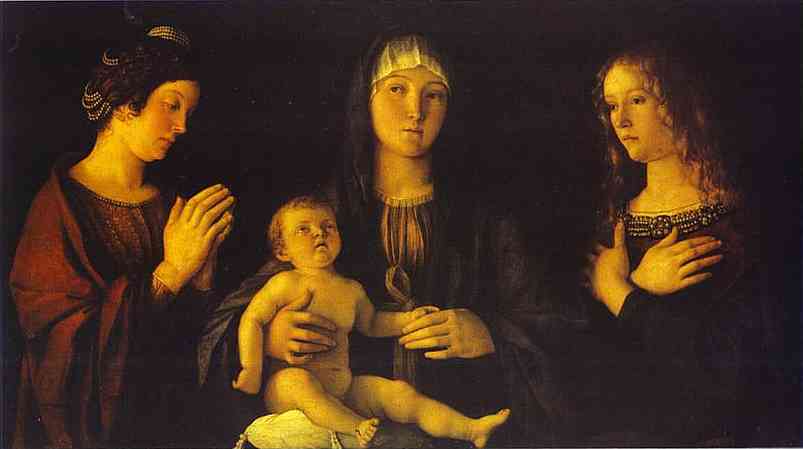
"Madonna and Child with St. Catherine and St. Mary Magdalen" by Giovanni Bellini. The figure of Mary Magdalen is on the cover of the newest edition of the above-mentioned novel.
Anyone care to speculate on the correlation?
A Poem
Nuptial
by Mary Fabyan Windeatt
There was a bride (the Gospel goes),
But whom she married no one knows;
Or if indeed she ever had
A likely lad.
Yet does it matter if she be
A shadow in antiquity?
That no man knows her height and weight
Or what she ate?
For of all brides who are, and were,
No one has ever equalled her-
That misty maid from the East
Who gave a feast.
Who was so gracious that the Lord
Came down to grace her wedding board;
To wrest the wine from the water
And woo a daughter.
Alas, that modern brides are girls
In satins and synthetic curls-
That no man dreams on Cana's child,
Who sipped...and smiled.
I thought that this was an interesting poem that goes with the Gospel from this past Saturday (and the Second Luminous Mystery). I was actually working on a short story about the wedding feast at Cana when I first read this.
God Bless
by Mary Fabyan Windeatt
There was a bride (the Gospel goes),
But whom she married no one knows;
Or if indeed she ever had
A likely lad.
Yet does it matter if she be
A shadow in antiquity?
That no man knows her height and weight
Or what she ate?
For of all brides who are, and were,
No one has ever equalled her-
That misty maid from the East
Who gave a feast.
Who was so gracious that the Lord
Came down to grace her wedding board;
To wrest the wine from the water
And woo a daughter.
Alas, that modern brides are girls
In satins and synthetic curls-
That no man dreams on Cana's child,
Who sipped...and smiled.
I thought that this was an interesting poem that goes with the Gospel from this past Saturday (and the Second Luminous Mystery). I was actually working on a short story about the wedding feast at Cana when I first read this.
God Bless
Tuesday, January 03, 2006
La Familia Brungardt
This picture was taken at our mini-family reunion on December 26th.

Kids in the front (l-r): Paul, Maggie, Luke, Grace, Luke, Anne, Therese, Andrew (in red), Gerard, Petra (in yellow), Jennifer, Mary Ann, Kaitlyn.
Middle row: Uncle Bruce, Fr. John, Aunt Elaine, Mom, Dad, Bryce, Frank, Aunt Sandi, Uncle Tom, Uncle Tony, Aunt Kathy.
Back row: Megan, Shantel, Catherine, Mike, Joe, Jen, John, Aubrey, Me.

Kids in the front (l-r): Paul, Maggie, Luke, Grace, Luke, Anne, Therese, Andrew (in red), Gerard, Petra (in yellow), Jennifer, Mary Ann, Kaitlyn.
Middle row: Uncle Bruce, Fr. John, Aunt Elaine, Mom, Dad, Bryce, Frank, Aunt Sandi, Uncle Tom, Uncle Tony, Aunt Kathy.
Back row: Megan, Shantel, Catherine, Mike, Joe, Jen, John, Aubrey, Me.
Wednesday, December 28, 2005
Star Wars: Episode III
I, the culturally deprived homeschooler, saw Star Wars: Episode III for the first time on Sunday. (Yeah, not much of a Christmas movie, but hey...) I was thoroughly terrified and disturbed. It was one of the scariest and most unsettling movies I have ever seen; scarier and more disturbing than LOTR, Harry Potter, any other Star Wars, Munich, or Crash; and almost as scary as Mystic River, though definitely not as disturbing.
It's just that Anakin’s path to redemption is so clouded; and in Episode III, you totally despair of any hope for him. The Star Wars saga as a whole is probably the most powerful story of redemption that I have ever seen in a movie, but in III, you despair, because even though you know how it turns out, there seems to be no hope. I mean (sorry for any spoilers, if the other 0.0034% of America that didn't see it is reading this), when he killed the kids, I was in shock. Jen can testify to this: when he was walking up to the Temple, I was like "what is he doing?" And then when he walks into the room with the kids I said, "no way. He's not...no way…" I have never seen anything like that, in that respect. And after that, it didn’t get any better. Only when Padme said (in a clichéd sort of way) “there is still good in him,” I remembered that he is redeemed and forgiven in the end.
I did like Episode III—a lot. It reminded me that Star Wars isn’t just some over-rated, computer-generated, sci-fi epic, but a story of love and redemption.
You could call it “The Prodigal Father.”
It's just that Anakin’s path to redemption is so clouded; and in Episode III, you totally despair of any hope for him. The Star Wars saga as a whole is probably the most powerful story of redemption that I have ever seen in a movie, but in III, you despair, because even though you know how it turns out, there seems to be no hope. I mean (sorry for any spoilers, if the other 0.0034% of America that didn't see it is reading this), when he killed the kids, I was in shock. Jen can testify to this: when he was walking up to the Temple, I was like "what is he doing?" And then when he walks into the room with the kids I said, "no way. He's not...no way…" I have never seen anything like that, in that respect. And after that, it didn’t get any better. Only when Padme said (in a clichéd sort of way) “there is still good in him,” I remembered that he is redeemed and forgiven in the end.
I did like Episode III—a lot. It reminded me that Star Wars isn’t just some over-rated, computer-generated, sci-fi epic, but a story of love and redemption.
You could call it “The Prodigal Father.”
Tuesday, December 27, 2005
More Random Pictures
These pictures were also taken by my dad on his cell phone thingy...

Anne on Christmas Eve

Luke with an expanding ball thing that he got for Christmas

Anne on Christmas day
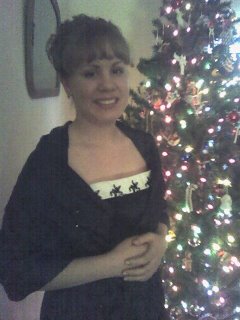
Me on Christmas trying on a dress that I got for $2 and an evening wrap that I got for Christmas...
...now I just need someone to ask me to the prom...
Anne on Christmas Eve
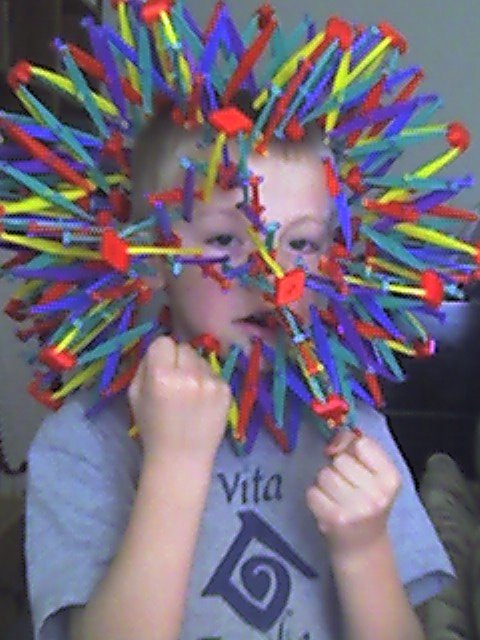
Luke with an expanding ball thing that he got for Christmas
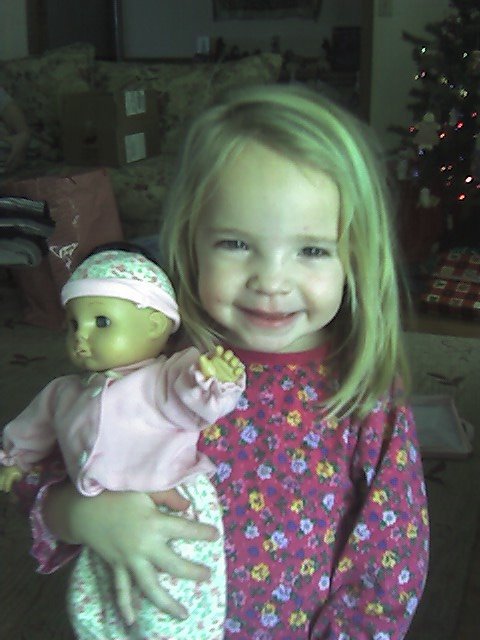
Anne on Christmas day
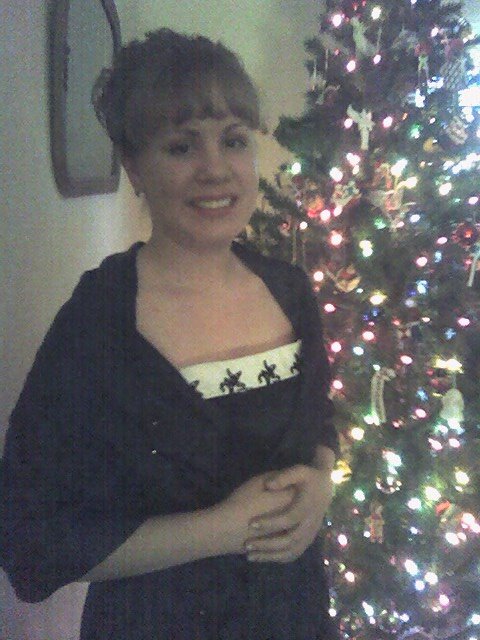
Me on Christmas trying on a dress that I got for $2 and an evening wrap that I got for Christmas...

...now I just need someone to ask me to the prom...
Saturday, December 24, 2005
Wednesday, December 21, 2005
Check This Out
Here's the new official website of my all-time favorite (and the world's best) writer, Mark Helprin.
www.markhelprin.com
www.markhelprin.com
Tuesday, December 20, 2005
Random Pictures
My Dad took these pictures with his new phone/camera/PDA/communicator/phaser/car battery/kitchen sink device. : )

Anne, John, Therese

Me before the dance

Jen before her performance (afterwards she came to the dance)
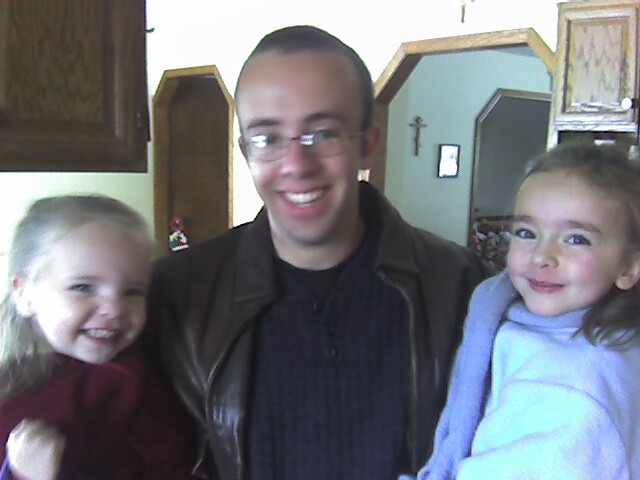
Anne, John, Therese
Me before the dance
Jen before her performance (afterwards she came to the dance)
My Dad on ZENIT
ZENIT - The World Seen From Rome 2005-12-16
Countering the Myth of the Perfect Child
Bioethics Courses Focus on "Neonatal Euthanasia" and Other Problems
ROME, DEC. 16, 2005 (Zenit.org).- Dr. Gerard Brungardt learned an unsettling fact when he came to Italy for an intensive weeklong course on bioethics.
The palliative care specialist from Wichita, Kansas, was surprised to learn that the average Italian woman has 12 sonograms during her pregnancy.
"It indicates our current fear of the non-perfect child," Brungardt said, "for which Dr. Bellieni has coined the term 'handiphobia' -- fear of the handicapped, the risks and realities of in vitro fertilization, embryo adoption, and neonatal/infant euthanasia."
He was referring to Dr. Carlo Bellieni, a neonatologist from Siena and self-described "fetus doctor" who teaches "The Myth of the Perfect Child" course during the week of studies at the Regina Apostolorum athenaeum's School of Bioethics.
A recurring theme in the many anecdotes Bellieni told his class of 80 students was how often parents reduce children to objects.
"We saw in this class how the child is no longer loved unconditionally and respected as a human person," said Dr. Laura Nino, a medical researcher from Houston, Texas, who participated in the course. Rather, the child is sometimes "seen as an object of possession which parents can dispose of when he or she falls short of their expectations," she added.
Amniocentesis
That sense of high expectations in parents can even lead to the death of perfectly healthy children in the womb.
Bellieni cited the example of prenatal diagnosis of Down syndrome and the proliferation of the use of amniocentesis. That surgical procedure involves inserting a hollow needle through the abdominal wall into the uterus of a pregnant woman and extracting amniotic fluid, which may be analyzed to determine the sex of the developing fetus, or the presence of disease or genetic defects.
"A healthy fetus dies for every 200 amniocenteses done which, for 35-year-old woman, is about the same risk as having a Down syndrome child," observed Bellieni.
"This means that in order to eliminate one Down syndrome child, we accept the risk of the death of another innocent child as an adverse effect of the amniocentesis," he said.
Bellieni sees a deeper problem lurking behind the overuse of amniocentesis and the widespread tolerance of abortion. That problem touches on interpersonal relations and even self-image, all of which he talks of in almost philosophical language.
"I" of the storm
"Most fundamentally, we cannot say 'I' anymore because saying 'I' would mean that we have found someone who has called us by name and loved us only because we exist, not because of our utility," Bellieni contended.
"This loss of the capacity to say 'I' leads to our loss of the capacity to say 'You' to the fetus," he added. "We do not love ourselves anymore and therefore we cannot love others. We see others, including the fetus, as a means and not as the end they truly are. One of the consequences of this outlook would be neonatal euthanasia."
"The Myth of the Perfect Child" is only one of several bioethics courses offered recently at Regina Apostolorum. The weeklong courses are offered twice each semester, and once during the summer to accommodate non-traditional students working toward degrees in bioethics.
Now in its fifth year, the athenaeum's School of Bioethics boasts 350 students from 30 countries. Lay people -- including politicians and health-care professionals -- study side by side with religious.
One of the invited guest speakers for next April's intensive courses is Dr. Edmund Pellegrino, the new chairman of the President's Council on Bioethics in the United States. More information about the courses is posted at www.upra.org or available via bioethics@upra.com.
Among those who came to Rome this year to deepen their knowledge of science -- and the faith -- was Jennifer Miller of New York.
"Coming from Fordham University," she said, "I saw that scientists get so desensitized that they forget what they are really doing. There is a need to re-humanize science with a focus on human dignity."
ZENIT home
Countering the Myth of the Perfect Child
Bioethics Courses Focus on "Neonatal Euthanasia" and Other Problems
ROME, DEC. 16, 2005 (Zenit.org).- Dr. Gerard Brungardt learned an unsettling fact when he came to Italy for an intensive weeklong course on bioethics.
The palliative care specialist from Wichita, Kansas, was surprised to learn that the average Italian woman has 12 sonograms during her pregnancy.
"It indicates our current fear of the non-perfect child," Brungardt said, "for which Dr. Bellieni has coined the term 'handiphobia' -- fear of the handicapped, the risks and realities of in vitro fertilization, embryo adoption, and neonatal/infant euthanasia."
He was referring to Dr. Carlo Bellieni, a neonatologist from Siena and self-described "fetus doctor" who teaches "The Myth of the Perfect Child" course during the week of studies at the Regina Apostolorum athenaeum's School of Bioethics.
A recurring theme in the many anecdotes Bellieni told his class of 80 students was how often parents reduce children to objects.
"We saw in this class how the child is no longer loved unconditionally and respected as a human person," said Dr. Laura Nino, a medical researcher from Houston, Texas, who participated in the course. Rather, the child is sometimes "seen as an object of possession which parents can dispose of when he or she falls short of their expectations," she added.
Amniocentesis
That sense of high expectations in parents can even lead to the death of perfectly healthy children in the womb.
Bellieni cited the example of prenatal diagnosis of Down syndrome and the proliferation of the use of amniocentesis. That surgical procedure involves inserting a hollow needle through the abdominal wall into the uterus of a pregnant woman and extracting amniotic fluid, which may be analyzed to determine the sex of the developing fetus, or the presence of disease or genetic defects.
"A healthy fetus dies for every 200 amniocenteses done which, for 35-year-old woman, is about the same risk as having a Down syndrome child," observed Bellieni.
"This means that in order to eliminate one Down syndrome child, we accept the risk of the death of another innocent child as an adverse effect of the amniocentesis," he said.
Bellieni sees a deeper problem lurking behind the overuse of amniocentesis and the widespread tolerance of abortion. That problem touches on interpersonal relations and even self-image, all of which he talks of in almost philosophical language.
"I" of the storm
"Most fundamentally, we cannot say 'I' anymore because saying 'I' would mean that we have found someone who has called us by name and loved us only because we exist, not because of our utility," Bellieni contended.
"This loss of the capacity to say 'I' leads to our loss of the capacity to say 'You' to the fetus," he added. "We do not love ourselves anymore and therefore we cannot love others. We see others, including the fetus, as a means and not as the end they truly are. One of the consequences of this outlook would be neonatal euthanasia."
"The Myth of the Perfect Child" is only one of several bioethics courses offered recently at Regina Apostolorum. The weeklong courses are offered twice each semester, and once during the summer to accommodate non-traditional students working toward degrees in bioethics.
Now in its fifth year, the athenaeum's School of Bioethics boasts 350 students from 30 countries. Lay people -- including politicians and health-care professionals -- study side by side with religious.
One of the invited guest speakers for next April's intensive courses is Dr. Edmund Pellegrino, the new chairman of the President's Council on Bioethics in the United States. More information about the courses is posted at www.upra.org or available via bioethics@upra.com.
Among those who came to Rome this year to deepen their knowledge of science -- and the faith -- was Jennifer Miller of New York.
"Coming from Fordham University," she said, "I saw that scientists get so desensitized that they forget what they are really doing. There is a need to re-humanize science with a focus on human dignity."
ZENIT home
Friday, December 16, 2005
Songs That Should Be in the CL Songbook
First, what is the CL songbook? Well, it's the 'official' songbook of Communion and Liberation. (CL Online) It has songs by everyone from Bob Dylan to Simon and Garfunkel to U2. There are also lots of traditional songs, Catholic hymns, African-American spirituals, and foreign-language songs.
Anyway, these are just some suggestions of mine for the songbook; songs that I think fit very well among the actual selections. They all have a 'CL' message and strike me as fitting additions.
"Hanging by a Moment"-Lifehouse
"Talkin 'bout a Revolution"-Tracy Chapman
"Clarity"-John Mayer
"Something's Missing"-John Mayer
"3x5"-John Mayer
"No Such Thing"-John Mayer
"The Great Divide"-Scott Stapp
"Broken"-Scott Stapp
"We Danced Anyway"-Deena Carter
"With Arms Wide Open"-Creed
"Higher"-Creed
"Crawling in the Dark"-Hoobastank
"This is Your Life"-Switchfoot
"Meant to Live"-Switchfoot
"Dare You to Move"-Switchfoot
"Pride(In the Name of Love)"-U2 (This is not only the 2nd best U2 song of all time, it's one of the few that is not in the songbook.)
"Walk On"-U2 (3rd best; and in case you're wondering, the #1 U2 song of all time is "Beautiful Day," which is in the book.)
"Caruso"-(Traditional Italian)
"Summer of '69"-Bryan Adams
"Better Days"-The Goo Goo Dolls
"Iris"-The Goo Goo Dolls
"The Scarlet Tide"-Alison Krauss
"You Will Be My Ain True Love"-Alison Krauss
"I Am a Man of Constant Sorrow"-Alison Krauss and Union Station
"Carry on Wayward Son"-Kansas
"Meet Virginia"-Train
"Shoulda Been a Cowboy"-Toby Keith (it's all about desire ; )
"Don't Stop Believing"-Journey
If anyone has any more ideas, please share them! Thanks for reading...
"Our voices sing with a reason."
Anyway, these are just some suggestions of mine for the songbook; songs that I think fit very well among the actual selections. They all have a 'CL' message and strike me as fitting additions.
"Hanging by a Moment"-Lifehouse
"Talkin 'bout a Revolution"-Tracy Chapman
"Clarity"-John Mayer
"Something's Missing"-John Mayer
"3x5"-John Mayer
"No Such Thing"-John Mayer
"The Great Divide"-Scott Stapp
"Broken"-Scott Stapp
"We Danced Anyway"-Deena Carter
"With Arms Wide Open"-Creed
"Higher"-Creed
"Crawling in the Dark"-Hoobastank
"This is Your Life"-Switchfoot
"Meant to Live"-Switchfoot
"Dare You to Move"-Switchfoot
"Pride(In the Name of Love)"-U2 (This is not only the 2nd best U2 song of all time, it's one of the few that is not in the songbook.)
"Walk On"-U2 (3rd best; and in case you're wondering, the #1 U2 song of all time is "Beautiful Day," which is in the book.)
"Caruso"-(Traditional Italian)
"Summer of '69"-Bryan Adams
"Better Days"-The Goo Goo Dolls
"Iris"-The Goo Goo Dolls
"The Scarlet Tide"-Alison Krauss
"You Will Be My Ain True Love"-Alison Krauss
"I Am a Man of Constant Sorrow"-Alison Krauss and Union Station
"Carry on Wayward Son"-Kansas
"Meet Virginia"-Train
"Shoulda Been a Cowboy"-Toby Keith (it's all about desire ; )
"Don't Stop Believing"-Journey
If anyone has any more ideas, please share them! Thanks for reading...
"Our voices sing with a reason."
Subscribe to:
Posts (Atom)

